
There are two cats who live rent-free in my head. One is a strung-out, cosmic being trying to meditate in a world that won’t stop spinning. The other is a sarcastic, loyal sidekick who, by the end of his story, learns to let go of language.
Let’s begin with Flow—the Latvian animation that somehow feels like a Buddhist parable disguised as a fever dream. The cat in Flow (let’s just call him Cat, because naming feels like an act of control and this cat resists all control) is the lone conscious anchor in a world sinking under rising waters. He floats—literally—on a boat cobbled together from accident, memory, and metaphor. He’s searching for something. A home? A sense of self? A litter box that doesn’t leak?
This cat’s journey is spiritual. He meets a cult of lemurs, a dog with identity issues, a bird who may or may not be a ghost. And through it all, Cat remains astonishingly… cat-like. Detached, curious, irritated by imposition. He embodies the feline tradition of mystical stoicism—an animal who could, at any moment, purr or ponder death. Probably both.
Then we have Jiji.
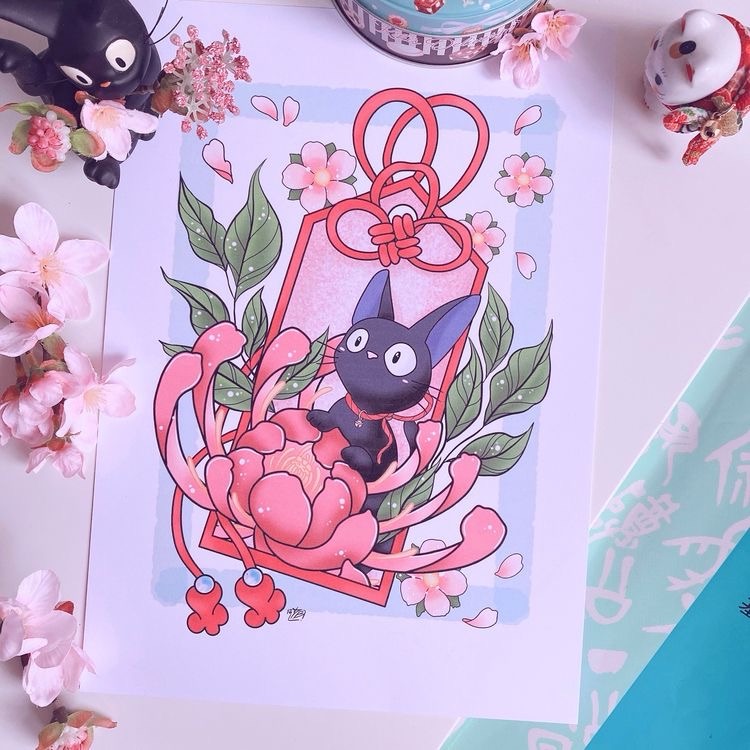
Jiji, from Kiki’s Delivery Service, is what would happen if the Greek chorus had a fur coat and a New Yorker accent. He is the voice in Kiki’s head, her translator for fear, doubt, and delight. He is witty, dry, anxious in the most charming way. Jiji wants pancakes. He wants safety. He wants things to make sense. And crucially, for most of the movie, he speaks.
But by the end of the film—spoiler alert for those who somehow missed this 1989 masterpiece—Jiji stops talking. Kiki can no longer hear him. The moment passes quietly, almost like background noise. But it is the moment.
Jiji’s silence is not loss. It is transcendence.
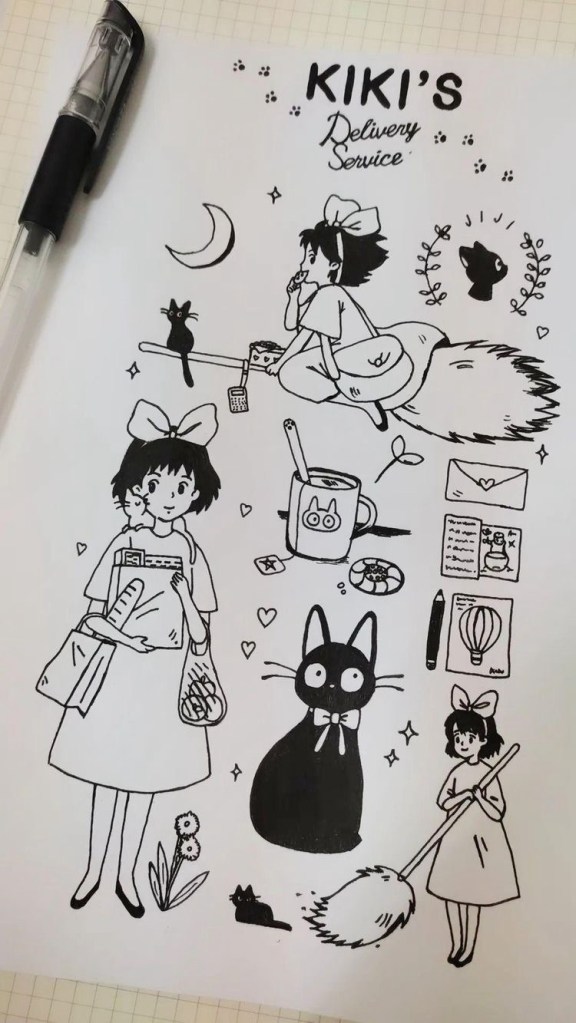
Because Kiki’s Delivery Service is a coming-of-age story, and Jiji’s voice was never just his. It was Kiki’s inner monologue, the comforting anthropomorphism of childhood. When she learns to stand on her own, to trust her instincts without explanation, she no longer needs a talking cat. Jiji doesn’t vanish. He just meows. As if to say, “You’ve got this now.”
So what do these cats teach us?
The Cat from Flow drifts toward connection but resists domestication. Jiji begins as a companion but transforms into a symbol of independence. One floats through absurdism toward inner peace. The other lets go of language as a form of growth.
Both are silent by the end.
And isn’t that something? That the journey of both cats—one animated in stop-motion surreality, the other in watercolor whimsy—leads not to louder meows, but to stillness. Silence as maturity. Silence as a gift.
You could call it a metaphor for adulthood. You could call it spiritual evolution. Or maybe it’s just that cats know something we don’t: that the deepest truths are found not in words, but in a good stretch of sun, a perfectly timed nap, and the quiet confidence of presence.
Either way, these cats aren’t side characters. They’re the philosophers we never knew we needed.
So next time you see a cat gazing into the middle distance, remember: they’re not ignoring you. They’re contemplating the eternal.
And probably judging your posture.


 Diligent Candy
Leave a comment