

I came back from ECER 2025 in Belgrade with a notebook that looked like a battlefield. Names squeezed into margins, arrows flying across the page, words like “trust”, “silence”, “evidence” underlined three times. It felt messy and disconnected at first. Once I started reading through it at home, a different picture appeared.

I kept returning to the session by Kiki Malte from Stockholm University on teaching in Swedish prisons. Fourteen teachers, one prison learning centre, a world that is organised around punishment. In my notes I had written phrases like “see a student, not a criminal” and “manage disgust”. That last one stopped me. We rarely say out loud that some situations and behaviours evoke disgust. Yet these teachers have to work with that feeling and still relate to people as learners. Kiki described how clothes, tone of voice and consistent fairness all signal that the classroom belongs to another moral universe. I realised that trust can be built with very small, very deliberate moves.
Then I noticed how often time appeared in my notes. Ellen Engelund and Paulla Mulinari introduced the idea of temporal racism while speaking about AI chatbots and immigrant student teachers. I had scribbled “previous work made invisible if did not work before…” which sounds cryptic, but I remember the feeling in the room. So many of us know people whose careers were interrupted by migration, parenting, war, illness. When institutions pretend that those years do not count as experience, the harm is not only economic. It is also a denial of who someone has been. Time becomes racialised and gendered.
On another page, the timing issue reappears with children. Helena Taylor from Uppsala and Alvyda Galkienė from Lithuania shared work on language disorders and written language difficulties. One sentence I wrote down was “always too late”. Children who form questions slowly often speak when the teacher has already moved on to the next activity. Their contributions become misread as lack of interest. Hearing this, I thought uncomfortably about how I, too, felt unseen when the teacher dwelled on the quick responder, often we forget the ones who live on a different rhythm, who think and feel deeply, but are unable to be specific.
Silence ran through the conference like a hidden river. Simone Leone’s presentation on global citizenship education frameworks made me rethink the silence of teachers around controversial global topics. I used to interpret that as a lack of courage. Simone argued that silence is institutional, not personal. Teachers are often given very basic information about complex geopolitical issues and almost no protection or support when conversations become sensitive. In that context, staying quiet feels less like cowardice and more like self defence.

The theme of inclusion came at me from many directions. Kati Kasem from the University of Tartu and Turana Abduljasova from Sheffield, working in the Estonian and Azerbaijani contexts, reminded me that teachers are expected to deliver inclusive education while still figuring out what that actually means. Their studies showed that stakeholders talk about valuing every child, yet teacher education often treats inclusion as a small, optional module. My margin note simply says “minor aspect of training, major aspect of reality”, which still feels true.
Another big cluster of notes is about evidence and knowledge. Vera Niederhäger in Switzerland, along with Paul Campbell and Melanie Ehren, unpacked the famous phrase “evidence-based practice”. I remember feeling relieved when someone finally said what I had been thinking. Not all evidence is created equal and not all of it is recognised. When school leaders only trust certain kinds of studies or certain institutions, they are not being neutral, they are reproducing hierarchies about whose knowledge counts. Gerard Ferrer Esteban’s comparative work reinforced this by showing how different systems define legitimate sources of knowledge in different ways.

The gender and leadership sessions were both inspiring and unsettling. Aysegul Abdurrahman and Ayse Donmez talked about Queen Bee dynamics, women in leadership who distance themselves from other women. I could feel the discomfort in my own body. It is easier to talk about “the patriarchy” as something out there than to acknowledge the ways women sometimes participate in keeping other women out. Margaret Grogan’s contribution reminded me that this is not simply about personality. Leadership itself is built on gendered ideals, so some lives and identities appear unintelligible in those roles unless we change the frame.
By the time I reached the end of my notebook, with references to Laura Elvie Smith on teacher mental health and with anticipation towards Marieke Toffolo’s clinical psychology class in Amsterdam (awaiting me) on anxiety and meta cognition, a pattern had formed.
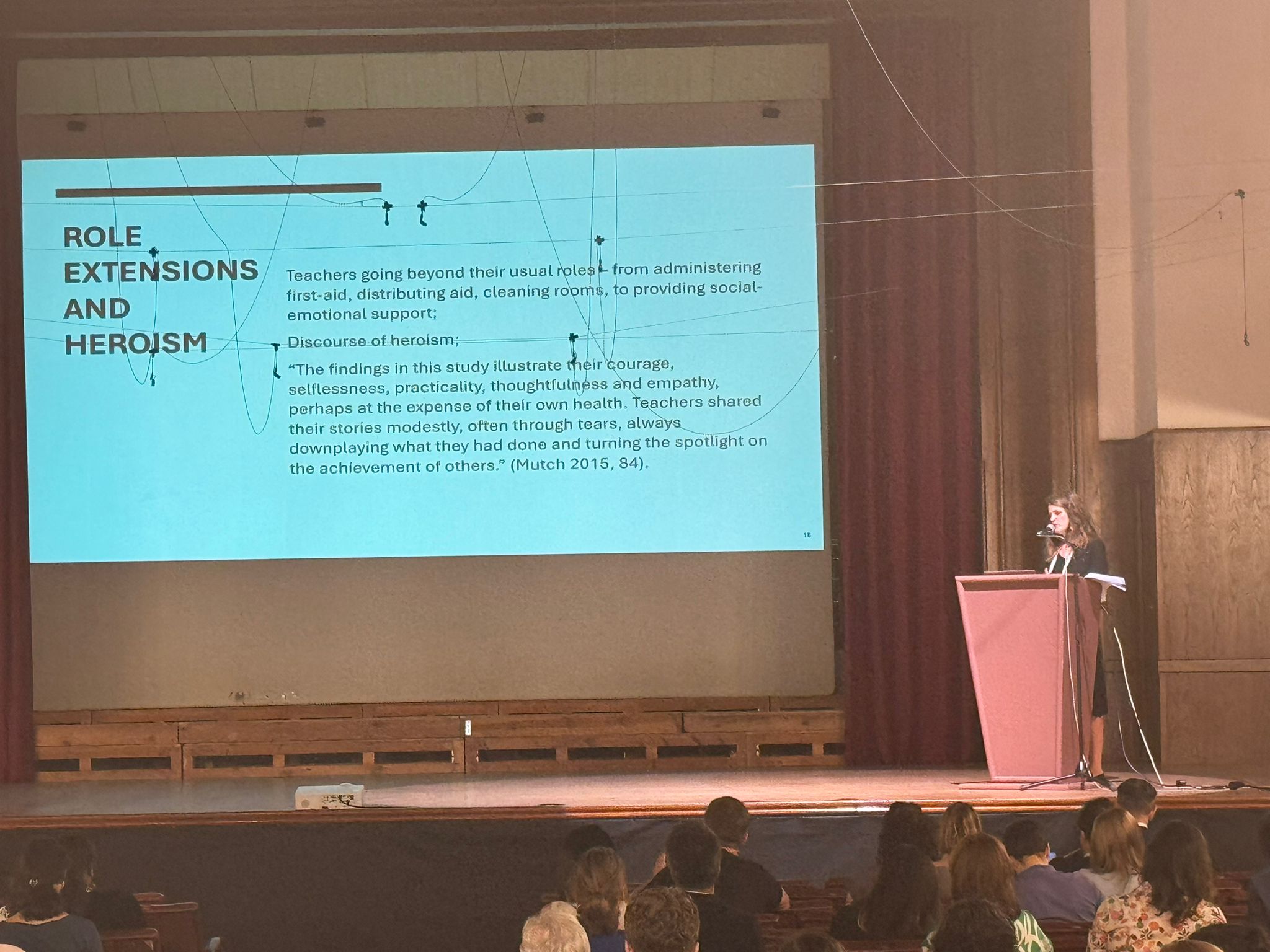
Teachers are asked to do incredibly complex emotional work, often without the training, protection or systemic support that would make it sustainable. Refugee teenagers ask them for peace education, children with deep disabilities need them to hear questions that arrive late, prisoners rely on them to see more than their crime, communities look to them for inclusion, and policy makers call for evidence based practice. Meanwhile, their own wellbeing is stretched thin.
What felt most profound about ECER 2025 was not a new theory. It was the insistence, across very different projects, that we stop explaining away problems as individual deficits. When we see silence, we should ask what risks the person is calculating. When we see absence at the leadership table, we should ask which norms define who looks like a leader. When we see a lack of evidence, we should ask whose data has been excluded.
I closed my notebook with one simple resolution. In my own work, I want to be more attentive to the invisible labour and the slow stories. I want to ask whose time, whose voice and whose evidence we are centring. ECER reminded me that the answers are rarely comfortable, but they are where genuine change begins.
What feels most profound
Across all these sessions, several shared insights stand out, I wanted to create a handy takeaway in case you, the reader, wanted to capture the conferences’ essence:
- Inclusion is emotional and relational, not only structural.
Whether in prisons, refugee workshops or mainstream classrooms, practices of inclusion depend on how teachers manage their own emotions, recognise students’ histories and create spaces where difference is not merely tolerated but meaningfully engaged.
- Silence and invisibility are institutional phenomena.
From Simone Leone’s global citizenship work to the experiences of immigrant teachers and racially minoritised students, silence often signals structural risk and misrecognition, not personal failure. Treating silence as a system property rather than an individual flaw opens new possibilities for change.
- Time is political.
Temporal racism, unrecognised prior work, delayed questions in class, late career teachers who are treated as novices, all point to the importance of whose timeframes are honoured. Education systems that assume linear, youthful, uninterrupted trajectories exclude those whose lives have been shaped by migration, care responsibilities, war or economic hardship.
- Knowledge and evidence are contested, not neutral.
The work of Vera Niederhäger, Paul Campbell, Melanie Ehren and Gerard Ferrer Esteban shows that the phrase “evidence based” hides significant debates. Which methods, whose data, which institutions. For more just education systems, teachers and leaders need not only skills to use evidence, but also critical literacy about its politics.
- Leadership and justice are deeply connected.
Gendered and racialised patterns of leadership are not side issues; they shape the entire culture of schools and universities. Without transforming who leads and how leadership is imagined, other reforms will always be partial.
Perhaps the most profound learning from these notes is that ethical teaching today cannot be reduced to technique or even to individual virtue. It is about building small, concrete practices of recognition and care inside institutions that often work against them, while also pushing to change those institutions. The researchers whose names fill my notebook are offering not only analyses of problems but also glimpses of how educators can act with courage and clarity in the midst of complexity. But do we have the gumption to support them?

 Diligent Candy
Leave a comment