
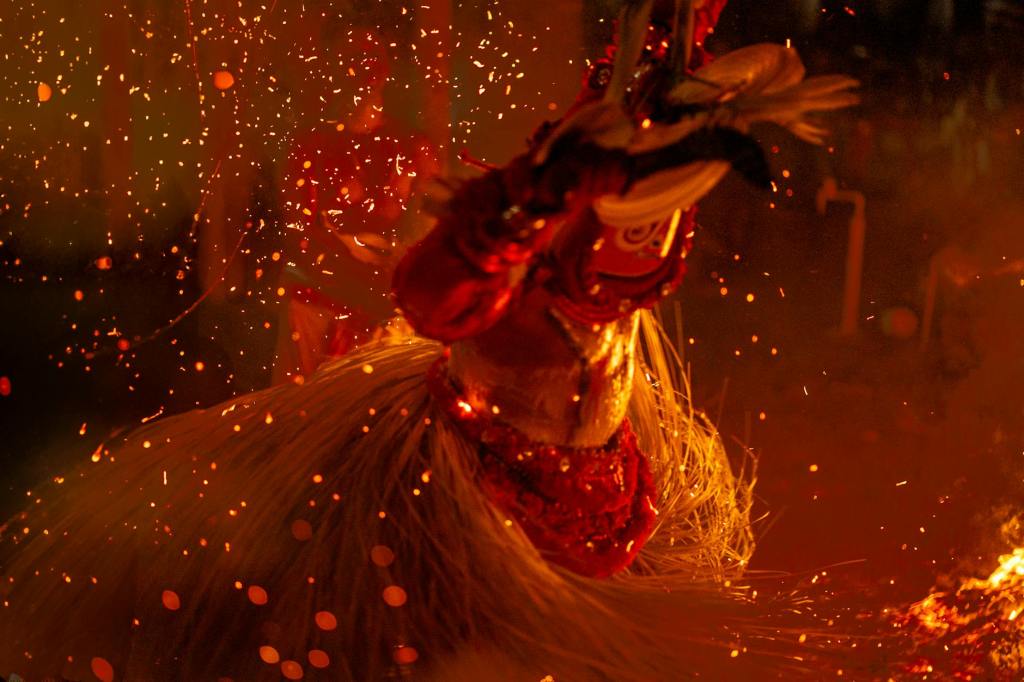
Begin with poetry, because urgency belongs in the line break. I come to Bhoota Kola to watch belief take form as measure and cadence, and to see Panjurli hold the boundary where neighbor, field, and forest meet. In that courtyard, law is patterned, it moves in count and return, it speaks in responsorial rhythm the way a chorus answers a lead.
Read through Jahan Ramazani, I learn how address, refrain, and petition align worship with lyric practice, how repetition thickens time so a community can receive and enact its own verdicts. I attend to the backstage where women keep tempo, textiles prepared, meals scaled, purity curated, the prosody that lets authority enter. I listen for the pāḍdanas as archive, not only content, but form, stanza and tune, caesura and call, a jurisprudence carried by antiphony.
I want scholarship that moves at this pace, philology beside performance studies, religious studies beside anthropology, with consent and credit set by custodians. Record variants with care, annotate untranslatables without flattening them, correlate turns in meter with turns in judgment, publish bilingual editions that keep breath and beat available to readers.
Fund this as infrastructure. When the rite travels to museums, festivals, and classrooms, let its obligations travel too, so what circulates is not only image, but the lyric law that remembers the field at dawn.

Introduction
This essay examines Bhoota Kola, also called Daiva Nema, a spirit possession ritual of Tulunadu in coastal southwestern India, with particular attention to Panjurli, the boar guardian. I read the rite at the intersection of religion and performance, that is, as worship enacted through choreographed embodiment, and as a village scale jurisprudence that adjudicates disputes, redistributes obligations, and renews social contracts. I also draw on Jahan Ramazani’s account of affinities among poetry, prayer, and ritual to clarify how repetition, refrain, and address form an infrastructure of attention that stabilizes belief and converts it into conduct.
Performance as Worship
To describe Bhoota Kola as folk theatre is insufficient, because it frames the event primarily as spectacle and brackets its juridical force. The ritual is better understood as performative worship. Through consecrating gestures, investment with regalia, and the donning of headgear, the performer is recognized as a medium for a localized deity. After this transition, petitions are received and verdicts are delivered. The liturgical sequence does not accompany decision making, it constitutes it. Gesture and costume set the conditions for speech to count as authoritative, and the choreography binds the community to outcomes that are recognized as binding because they have been publicly witnessed and ritually produced.
Panjurli’s Mandate, Ecology and Boundary
Panjurli exemplifies the ritual’s ecological intelligibility. As a boar spirit he signifies the nonhuman appetite that threatens cultivation, yet as guardian he disciplines the edge between forest and field. This dual figure encodes the social negotiation that sustains agrarian life, a recognition that production depends on restraint. Disputes brought before the deity commonly mirror this logic of limits, questions of bunds, trees, and permissions. Resolutions are issued as instruction, and they are paired with redistributive acts, offerings and feasts that metabolize conflict into managed reciprocity. In this sense, worship operates as repair. It converts grievance into guidance and reorients neighbors toward a shareable future.
Gendered Labor and the Backstage of Authority
The visible authority of possession rests on an economy of care that is largely off stage and often gendered. Women maintain textiles, prepare food at scale, curate ritual cleanliness, and manage supplies. Men typically enact the public risk of trance, carry weapons, and bear regalia. When this backstage labor is unnamed, authority appears as uncaused charisma. When it is acknowledged, the rite becomes legible as a collaborative production of justice, with women’s work providing the continuity and credibility that make verdicts livable. Migration and wage labor are reshaping these distributions, consequently the ritual is a sensitive index of changing household economies and the elasticity of custom.
Regalia as Syntax, Costume as Semantics
Ritual costume functions as a grammatical system much like the formal requirements of performative poetry. The halo like backpiece frames radiance, anklets convert footwork into percussive speech, mirrors index vigilance, vegetal materials preserve agrarian scent and signification, and metal anchors vow. Repairs and patches accumulate as a small archive of the rite’s economic history. To economize on regalia is not only to diminish spectacle, it is to blur the sentence that the body must speak. The body did speak with the ghazal (Das 2022). The semantics of authority attenuate when the material text is poorly made, and with that attenuation the clarity of judgment also weakens, since it relies on the credibility of the embodied medium.
Pāḍdanas, Orality, and Custodianship
The long Tulu narrative songs, the pāḍdanas, are the textual reservoir of Bhoota Kola. They braid origin, territory, genealogy, obligation, and miracle, and they advance meaning through antiphony, a lead and chorus that move the narrative forward by call and response. Transcription risks flattening these features because the songs live in tune, breath, and responsiveness to audience and place. Responsible documentation requires patient listening, careful glossing keyed to local toponyms and kinship terms, and an ethic of custodianship that recognizes communal ownership and the responsibilities attached to transmission.

Poetics, Prayer, and Ritual, a Theoretical Bridge
Ramazani’s account of the kinship among poetry, prayer, and ritual clarifies why Bhoota Kola holds juridical and religious force. Poetry and prayer share forms of address that open a corridor between human and more than human interlocutors, and both rely on refrain and repetition to train attention. Ritual intensifies these properties by binding address and repetition to action within a public frame. In Bhoota Kola, refrain is audible in drum patterns and responsorial song, and visible in repeated gestures that cue recognition. Through repetition, time becomes thick, memory is recruited, and the community is rendered ready to receive and enact what it requests. In this light, performance is not a vehicle for preexisting belief, it is the instrument that tunes belief into conduct.
Travel, Mediation, and the Terms of Display
Forms travel. When they do, they carry prior meanings and acquire new ones. Poetry’s migrations, for example, demonstrate how inherited constraints can be bent toward new urgencies or tightened to restore rule consciousness, always within changed social conditions. Rituals travel as well, invited by cameras, festivals, and classrooms. Travel can shelter or extract. The critical question concerns terms. To sustain meaning, mobile performance requires chaperonage, elders, singers, and craft keepers who negotiate conditions of display so that obligation is not discarded at the threshold of a new venue. Otherwise, what circulates is an emptied aesthetic, legible to audiences yet detached from the responsibilities that originally gave it force.
Jurisprudence with a Landscape
If Bhoota Kola is a court, it is a court with a landscape. The shrine typically sits at the contact zone of settlement and grove. The law enacted here is ecological before it is clerical, that is, it protects a commons through praise, taboo, and sanction. Panjurli’s animal form functions as a memory device that keeps agriculture honest by reminding it of other appetites. Cultivation without restraint becomes extraction, worship without obligation becomes alibi. The rite therefore rehearses a grammar of limits appropriate to a more than human neighborhood.
Conclusion
By the end of a night, truth telling has exacted a metabolic price. Authority has been worn, carried, and danced. The community has paid attention with its body. This expenditure is not incidental, it is constitutive. It materializes the cost of judgment, it calibrates the seriousness of the outcomes, and it inscribes the verdicts in muscles and breath as well as in memory. Ramazani’s insight helps to name this structure. Prayer is not only petition, it is a practice that prepares a people to receive what they seek. In Tulunadu, the prayer is danced, sung, stitched, cooked, and publicly answered. The lyric is not only on the tongue, it is in ankle bells and shared meals. Lamps are finally extinguished, regalia is untied, and the medium returns to a personal name. The field waits for morning, the edge remains a site of vigilance. Panjurli will be called again, because appetites persist, because obligation requires rehearsal, and because communities that wish to endure must repeatedly convert belief into conduct within a public ritual frame.

Claus, Peter J. “Mayndala: A Legend and Possession Cult of Tulunad.” Asian Folklore Studies, vol. 38, no. 2, 1979, pp. 95–129.
—. “The Siri Myth and Ritual: A Mass Possession Cult of South India.” Ethnology, vol. 14, no. 1, 1975, pp. 47–58.
—. “Spirit Possession and Spirit Mediumship from the Perspective of Tulu Oral Traditions.” Culture, Medicine and Psychiatry, vol. 3, 1979, pp. 29–52.
Das, Amrita. The Graph of a Cry: Mapping the American Ghazal’s Literary History, 1960–2010. Vrije Universiteit Amsterdam, 2022. PhD thesis.
Freeman, Rich. “The Teyyam Tradition of Kerala.” The Blackwell Companion to Hinduism, edited by Gavin D. Flood, Blackwell, 2003, pp. 306–326.
Honko, Lauri. Textualising the Siri Epic. FF Communications 264, Suomalainen Tiedeakatemia, 1998.
Honko, Lauri, and Gopala Naika. The Siri Epic as Performed by Gopala Naika. Vols. I–II, FF Communications 265–266, Suomalainen Tiedeakatemia, 1998.
Ishii, Miho. Modernity and Spirit Worship in India: An Anthropology of the Umwelt. Routledge, 2020.
Ramazani, Jahan. Poetry and Its Others: News, Prayer, Song, and the Dialogue of Genres. University of Chicago Press, 2013.
Rai, B. A. Viveka. “Epics in the Oral Genre System of Tulunadu.” Oral Tradition, vol. 11, no. 1, 1996, pp. 163–172.
Suzuki, Masakatsu. “Bhūta and Daiva: Changing Cosmology of Rituals and Narratives in Karnataka.” Senri Ethnological Studies, no. 71, 2008, pp. 51–85.
Saraswat, Abhishek. “The Myth of Panjurli and Guliga in Kantara (2022).” Religions, vol. 15, no. 11, 2024, article 1307.

 Diligent Candy
Leave a comment