
This week, on April 15th, I had the honour of delivering the opening keynote for the Social Safety Week 2026 at the Conservatorium van Amsterdam, a programme that understands something many institutions still struggle to name: that social safety is not a decorative value to be displayed at the edges of institutional life, but part of the ground on which learning, teaching, and artistic becoming stand. Running from 15 April to 12 May, the programme brings together trainings, dialogue sessions, and interactive meetings for students and staff, all under a sustained commitment to a socially safe and inclusive learning and working environment.
My keynote was titled Social Safety in Arts Education: Shared language, multiple perspectives, and the work of institutional responsibility. I began with the term itself, with its apparent simplicity, and its refusal to remain simple.
Social safety is one of those phrases that seems, at first glance, to arrive already understood. But the moment we ask what it means, and for whom, the word begins to open. For some, it names an interpersonal condition: the possibility of entering a room without shrinking, of speaking without fear, of being met with respect, of learning without humiliation. For others, it names something heavier, slower, more sedimented: structures of power, exclusion, harassment, discrimination, unequal conditions, and the institutional habits through which some injuries are quickly recognised while others are asked to live in shadow. These are not competing meanings. They are different registers of the same terrain. Often, one is how the other is felt in the body.
And the body, of course, is never generic.
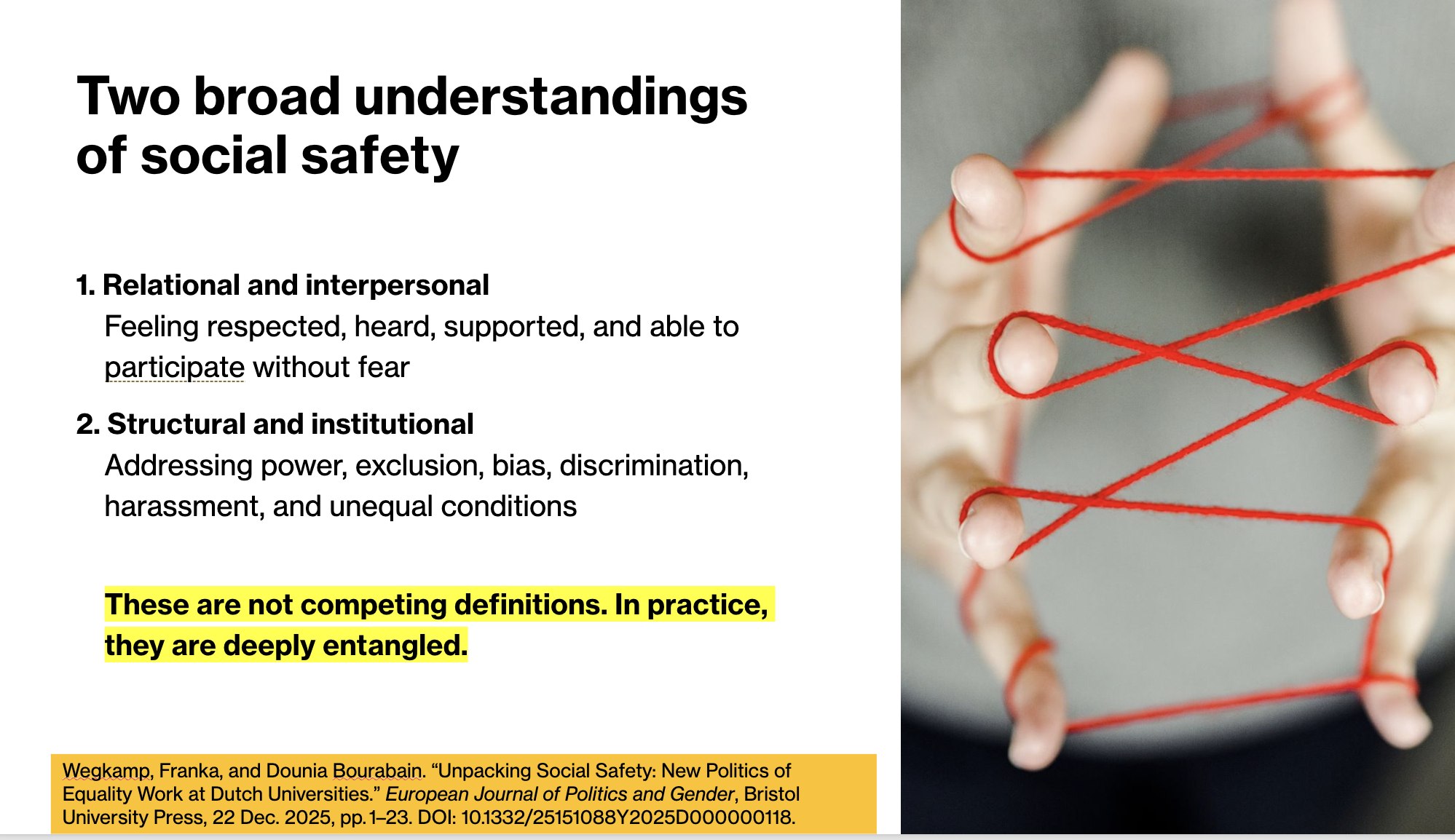
Social safety is not experienced evenly across a community. It is shaped by the crossings of gender, race and ethnicity, class, sexuality, disability, nationality, language, religion, status, and seniority. The same corridor can feel ordinary to one person and charged to another. The same classroom can invite speech from some and careful silence from others. The same institution can appear generous from one angle and withholding from another. So any serious conversation about social safety must resist the comfort of the universal. Safe for whom is not an afterthought. It is the question beneath the question.
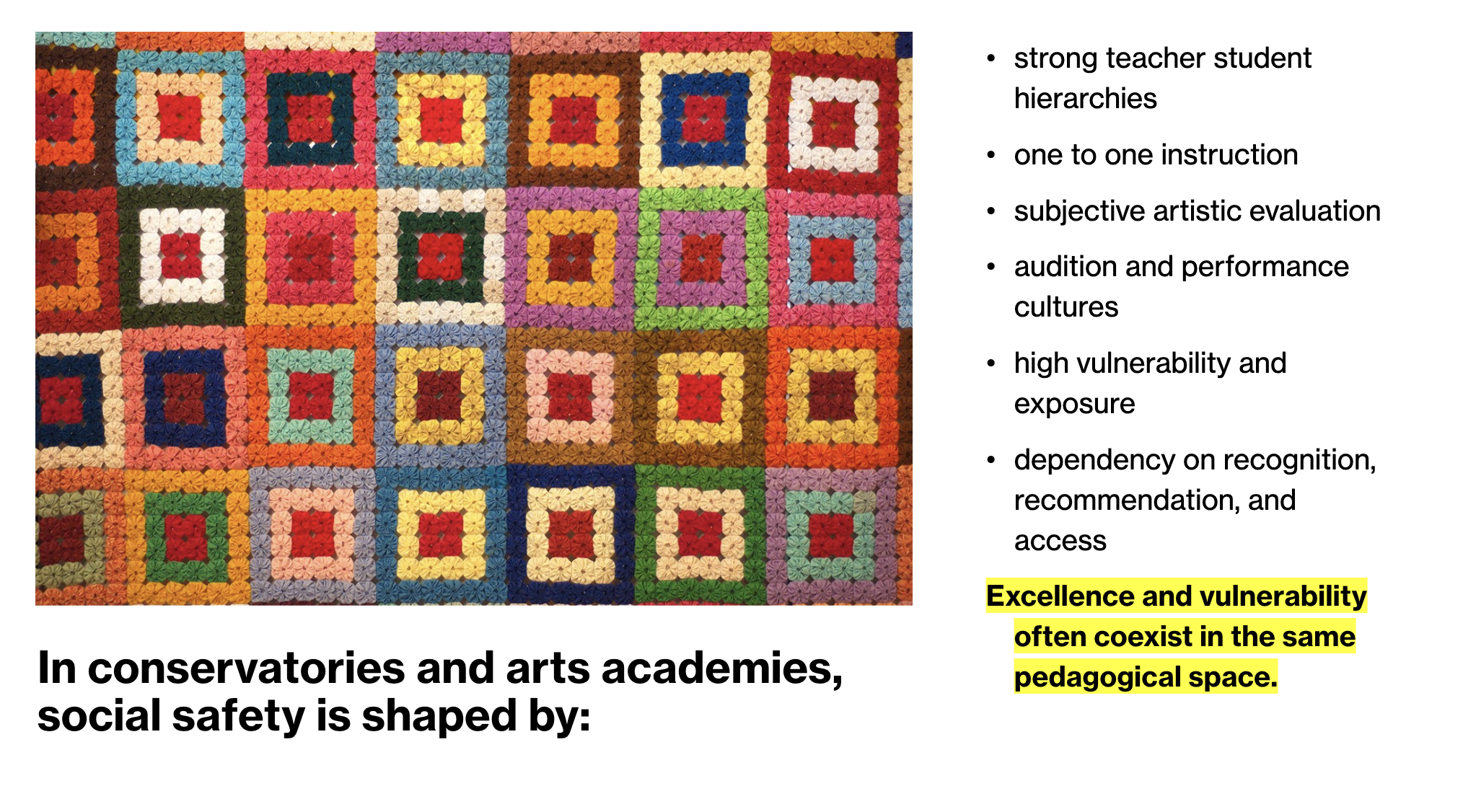
In arts education, this question becomes more delicate, and more urgent.
Conservatories and arts academies are places where aspiration is sharpened in public and private, where craft is formed through repetition, exposure, critique, dependence, and risk. They are also shaped by strong teacher-student hierarchies, one-to-one instruction, subjective artistic evaluation, audition and performance cultures, and a profound reliance on recognition, recommendation, and access. In such spaces, vulnerability is not incidental to pedagogy. It is often woven into its very structure. Excellence and vulnerability do not merely coexist here. They lean against one another. They arrive together in the same lesson, the same rehearsal room, the same audition, the same silence after feedback.
This is why the language of social safety in arts education must be both precise and brave. The question is not whether education should be free of discomfort. It should not. Real learning unsettles. Art, perhaps more than many other forms of study, asks for exposure to uncertainty, to judgment, to revision, to the ache of not yet knowing how to become what one senses is possible. Discomfort can be the weather of growth.
But harm is not the same as difficulty.
Humiliation is not rigour. Fear is not depth. Silence is not consent. Endurance is not proof that a pedagogy is sound. And institutions betray both art and education when they inherit cultures of abrasion and call them excellence, or preserve unequal dependencies by dressing them in the language of tradition.
One of the central questions of the keynote was therefore this: when does discomfort belong to learning, and when does it become harm?
I return to that question because it refuses both sentimentality and denial. It does not permit us the ease of saying all difficulty is valuable, nor the convenience of imagining that all discomfort is violence. Instead, it asks more of us. It asks for judgment. For literacy. For careful distinctions. For institutional honesty. It asks us to consider what students and staff should be protected from, what forms of challenge remain necessary to education, what responsibilities belong to individuals, and what responsibilities belong to institutions. Social safety, if it is to mean anything at all, must be able to hold these questions together without flattening them.
As a communications and intercultural specialist, I find myself returning again and again to the matter of language. Not because language alone can resolve structural inequality, it cannot, but because institutions live and fail through the vocabularies they have, and the ones they do not. Without shared and careful language, institutions become blunt where they need nuance, evasive where they need clarity, procedural where they need moral seriousness. They overgeneralise. They euphemise. They defend too quickly. To speak well about social safety is not performative excess. It is part of the work itself. We need language capable of naming experience without reducing it, naming power without abstraction, naming accountability without spectacle, naming repair without pretending repair is simple.
This is also, fundamentally, an intercultural task. Educational spaces are never neutral containers. People do not arrive with identical relationships to authority, critique, shame, directness, conflict, visibility, or belonging. What feels open to one person may feel exposing to another. What seems neutral may be saturated with unspoken norms. What is praised as resilience may, in fact, be the repeated labour of adapting to conditions one did not shape. To work seriously on social safety, then, is also to develop intercultural attentiveness, the capacity to understand that communication is not merely about what is said, but about position, history, interpretation, risk, and who is expected to carry the burden of adjustment.
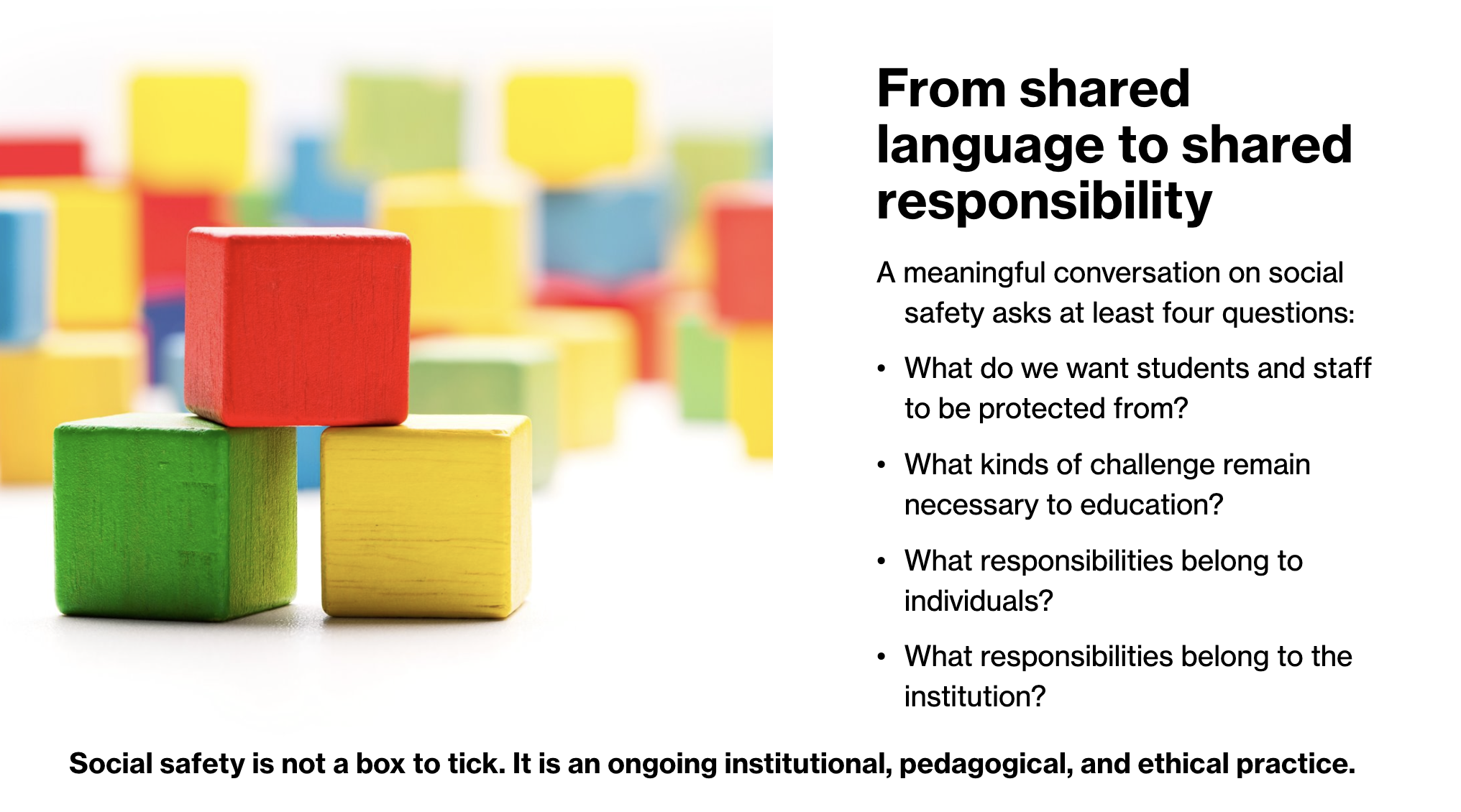
This is one reason I so appreciated the design of the Conservatorium van Amsterdam’s Social Safety Week. The programme did not imagine that a single statement, or a single event, could do this work. It built an ecology instead: sessions on consent and inappropriate behaviour, bystander intervention, teacher perspectives on social safety, peer feedback culture, boundary-setting in professional practice, and social cohesion and mutual respect. That breadth matters. It suggests that social safety is not one issue but many, not one conversation but a field of conversations, practices, and responsibilities that must be revisited, rehearsed, and renewed.
The campaign line for the month was striking: Boundaries set the tone. Beneath it sat another line: Learning, listening, building safety together. I carried both with me. Because boundaries, in educational life, are not what diminish freedom. Often, they are what make freedom livable. They are what allow critique without cruelty, ambition without exploitation, openness without coercion, and challenge without the normalisation of harm.
This work is not neat. It does not arrive with clean endings. It is contested because institutions are contested. It is uncomfortable because power rarely loosens itself without friction. It is difficult because it asks us to look again at what has long been normal, and to listen for what the ordinary has been costing others.
And still, this is the work.
Not because institutions can become innocent, they cannot. But because they can become more attentive. More exact. More humane. More capable of recognising that dignity is not a soft add-on to education, but part of its condition. More willing to ask what kinds of worlds are being made, every day, in the ordinary choreography of teaching, feedback, authority, judgment, aspiration, and belonging.
My warm thanks to Okke Westdorp and Jonathan Szegedi for the invitation, the trust, and the care with which this important week was shaped. It was a privilege to open the Social Safety Week 2026 at the Conservatorium van Amsterdam, and to join a conversation willing to treat social safety not as a slogan to display, but as a difficult, living, collective practice.




Leave a Reply